
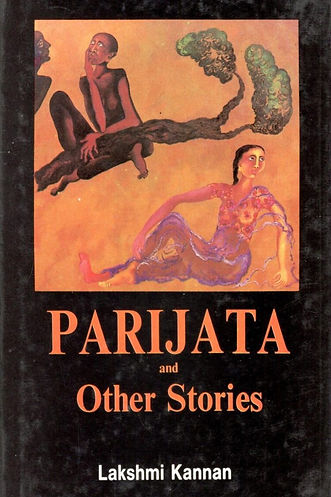
Parijata and Other Stories
Original Title:
Venmai Porthiyadhu
National Publishing House, New Delhi
1992
Originally written by:
Lakshmi Kannan
Translated by:
Lakshmi Kannan
Original Language:
Tamil
Translated Language:
English
BOOK DESCRIPTION
Parijata and Other Stories is a compelling collection of fourteen short stories by Lakshmi Kannan, translated by the author herself from the original Tamil. Blending literary elegance with emotional insight, these stories illuminate the inner lives of ordinary people confronting extraordinary moments of choice, loss, resilience, and transformation. The author's self-translation preserves the lyrical beauty, cultural nuance, and psychological depth of the original, making this collection an outstanding contribution to Indian literature in English.
The stories move across diverse landscapes, from the cultural heartlands of Tamil Nadu to international settings, examining themes of women's autonomy, identity, social expectations, race, prejudice, spirituality, mortality, and the universal search for dignity. Through memorable characters and finely crafted narratives, Lakshmi Kannan reveals the quiet courage of individuals who seek freedom from restrictive traditions while remaining deeply rooted in their cultural heritage.
Praised by critics for its artistic excellence, psychological depth, and authentic translation, Parijata and Other Stories has been recognized as a significant work of literary fiction that connects readers with the richness of Tamil culture and contemporary Indian experience.
An essential collection for readers of Indian fiction, Tamil literature in translation, literary short stories, women's writing, feminist literature, world literature, and translated classics, this volume offers timeless stories that continue to inspire thoughtful reflection and emotional engagement.
Cover credit: ‘TIME-IMAGE: 1990’ by Arpana Caur, a renowned artist
Oil on canvas 68” x 74”
REVIEWS
In the Crucible of Consciousness by Sukrita Paul Kumar
A short story seeks to grasp the inevitability of an experience, an incident or a specific dimension of a relationship within its folds. It reveals at times, the utter simplicity of the apparently complex reality; or interestingly, it may focus on a peculiar complexity of a rather plain-looking event. Lakshmi Kannan’s remarkable alertness and sensitivity in capturing and exploring experiences in their live colours makes one get drawn into her recent collection of short stories, Parijata and Other Stories. Her stories project one concern significantly, the urgency for self- expression in some of her characters who are conscious of the potential for freedom from obsolete patterns of existence.
That the stories are translations from the original Tamil dawns upon us only through the information provided by the author of the book. It is perhaps because the translator is the author herself that the stories are charged with the inspiration of the original. Being a poet in English, Lakshmi Kannan’s sensitized feel for the English language must have indeed helped her in transporting experience encapsulated in such a tonally rich language such as Tamil.
Parijata is a welcome addition to the not- so- rich world of literary translations in India. These stories establish a contact with the Tamil world, secure in its particular, cultural identity and world view.
The majority of men and women feels secure in playing socially assigned roles with a comfortable complacency. It is the rare few who strive for individual space and the right to exercise their personal choice for their action. Endowed with the strength of conviction, Lakshmi Kannan’s women characters are restless to break open the constrictive prison house of their existence. In the story titled “India Gate”, the huge arch of the India Gate in Delhi evolves as a symbol of freedom for Padmini. Its openness is contrasted with the small, shallow arch of the door at the backyard in Trichy, the door that keeps the women enclosed within the four walls of the house, spending their lives serving the men and living on “the dregs and lumps of old rice, the thin yoghurt and lentil scratched out from the bottom of the vessel." For Padmini, an educated woman with a career of her own, the oppressive world has to collapse. The back door enlarges, dilating and swelling up to the huge passage through which she has collected the courage to pass and have a house of her own.
The stories “Maria” and “Sable Shadows” unfold the ambiguity of sexual mores. The first-person narratives giving accounts of the author’s experience at the Iowa International Program, focus attention on gender bias, racial prejudices and colour consciousness.
On the other hand, stories such as “Parijata”, “A Place in the Sun” and “Thirteen Days After” offer autonomous universes involving the reader’s full participation. The writer is almost absent. In “Parijata” however, she flouts the upper-class old woman’s attitude to the widow by identifying the unfortunate widow with the sacred flower, Parijat. The shell of fixed notions is seen cracking.
Even though predominantly these stories have a female consciousness at the center, in some stories it is the deprived or the exploited male who is the main concern. What obviously interests the author is the lot of the oppressed, be that male or female. The victims have to salvage themselves from “zeroing into” nullity by their effort, through a sensitive cognition of their predicament.
The narrative of the successful stories runs through poetic metaphors, a combination of symbolic language and realistic representation to arrive at epiphanic endings. The endings of some of her stories offer the possibilities of the beginning of authentic living. A good short story, after all, strives to strip reality of its fictionality.
Review of Parijata and Other Stories, The Weekend Observer, Saturday, June 6, 1992.
“Confronting the Existential Truths” Christine Gomez
All the fourteen stories are carefully crafted pieces with graphic settings, significant themes, innovative techniques and memorable characters.
The venue of “Maria” and “Sable Shadows in the Witching Time of Night” is the International Writing Program at Iowa, USA. Both the stories reveal a sensitive portrayal of human relationships and a wistful longing for a better understanding between people, especially writers, untrammelled by prejudices concerning colour, race, nationality and gender.
The story “Sable Shadows” is remarkable for the magnificent portrayal of a Nigerian writer Vincent Chukuemeka Ike, a brilliant, caring intellectual, tall, hefty, strong, gentle and magnanimous. He literally and metaphorically towers, head and shoulders, above the narrow-minded, scandal-mongering people around him. A haunting metaphor that stalks through the whole story is that of the black panther, identified with Ike.
A feminist streak is noticeable in many stories. The women protagonists move out of the oppressor-victim ambit, choosing to be “non-victims”, to use Margaret Atwood’s phrase.
Albert Camus mentions death as the ultimate evidence of the absurd, which confronts man with an existential vision of the universe and self. In three of the stories in this collection – “Thirteen Days After,” “The Turn of the Road” and “Please, Dear God” – a close encounter with death gives an individual a new perspective on life. The translation is a highly competent one that recaptures the tone of the original.
“Confronting the Existential Truths”, Review by Christine Gomez, The Book Review