
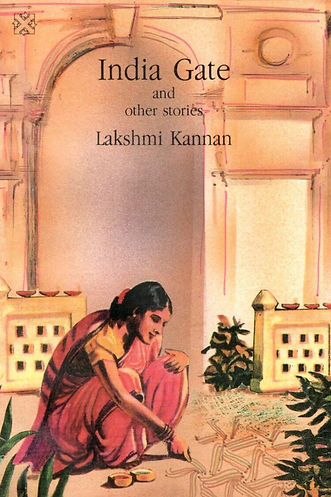
India Gate & Other Stories
Original Title:
India Gate
Disha Books Orient Blackswan, New Delhi
1993
Originally written by:
Lakshmi Kannan
Translated by:
Lakshmi Kannan
Original Language:
Tamil
Translated Language:
English
BOOK DESCRIPTION
India Gate and Other Stories is a distinguished collection of sixteen short stories by Lakshmi Kannan, translated by the author herself from the original Tamil. Published by Orient BlackSwan, this remarkable volume captures the richness of India's multilingual and multicultural heritage while presenting deeply human stories that resonate across cultures. Through her sensitive self-translation, Kannan preserves the emotional depth, cultural authenticity, and literary elegance of the original Tamil narratives.
The stories explore the complexities of identity, family, gender, memory, social conventions, and personal freedom. Set across diverse locations in India and beyond, they portray individuals negotiating tradition and modernity with quiet courage and emotional honesty. Kannan's memorable characters, particularly her strong yet nuanced women, seek dignity, self-expression, and inner freedom without losing sight of the cultural worlds they inhabit. Her storytelling combines vivid atmosphere, psychological insight, and graceful prose to create narratives that linger long after the final page.
Acclaimed by leading critics for its literary excellence, authenticity, and powerful portrayal of contemporary life, India Gate and Other Stories stands as an important contribution to modern Indian literature in translation.
An essential read for lovers of Indian fiction, Tamil literature in English, literary short stories, feminist literature, contemporary Indian writing, world literature, and translated classics, this collection offers timeless stories of resilience, humanity, and hope.
Cover: Painting oil-on-canvas by Saradambal, a renowned artist and the author’s mother.
Design: Bharati Mirchandani
REVIEWS
Review by Sukrita Paul Kumar
Written originally in Tamil and translated into English by the author herself, India Gate and Other Stories is a collection that makes the typical multi-lingual, multi-cultural Indian ethos come alive with its own native energy. To blend the exclusivity of the Tamil world with the capsulated Anglophile is a task that can be executed only through a sensibility that is steeped equally intensely in both the languages – Tamil and English. The reality of each of the two worlds has been internalised and the tension between the two is realistically maintained.
These stories are ardent attempts at exploring the complexity of the individual as well as the cultural identity in existential and convincing terms. The two rather diverse worlds, cannot be synthesized. Nor can easy conclusions be drawn. The writer, therefore, has to have the capacity to retain the actual sounds, smells and visuals along with demonstrating the ability to accommodate and leap into what Lakshmi Kannan calls a “spatially larger time frame.”
It is obvious from the Translator’s Note that Kannan is an alert translator, as conscious of the theory of translation, as of its practice. She records the insights that emerge from her experience of translation: ‘Only translation can unlock a work and also give it an acid test, if it can stand on its own, in another language.’ The stories in this collection which grow their own limbs most naturally and impressively are “Phantoms of Truth” and “Muniyakka”.
In “Phantoms of Truth”, what appeals to one immediately is a sensitive merger of the physical atmosphere into the psychic reality of the characters. There is a delicate balance between the truth of a self-created illusion and its perception as a lie. It highlights the inherent scope of a human psyche to identify with, and accommodate the elemental surges of the sea itself, even in urban characters.
Kannan’s stories often revolve around strong-willed women characters working their way out in a traditional society. These women have to realise their own space tactfully and subtly. Not for them an overt rebellion. They have to be intelligent enough to perceive the futility of insular individual protests in a sturdy and conservative social framework. So Muniyakka, though quite capable of experiencing the dignity of her own individuality as against the male oppression, has evolved an apt strategy for self-expression through sheer natural intelligence: ‘Muniyakka had mastered the art of soliloquy. She would keep muttering to herself as she walked, mutter to herself fluently, without any hesitation. The most meaningful conversations she had were the ones she had with herself.’ This is the poetics of feminism, a compulsive consciousness of the need to communicate, first and foremost, with one’s own self. ‘Everyone got used to the way this old woman freely held forth with herself.’
Financial Express, New Delhi, Sunday, August 22, 1993
“No Mere Feminist Declarations” Review of India Gate and Other Stories by Asokamitran
This is the third collection of short stories by the author and is probably intended as a selection of her best works so far. Lakshmi Kannan is her own translator. Her English prose is fluid, the rendering taut.
Recent years have seen a certain compulsive urge in women writers of the third world to write stridently about the injustice and repression meted out to women for centuries. Though Lakshmi Kannan’s stories are not feminist declarations, they touch the sensitive recesses of the human mind, unfolding the basic inhumanity and selfishness of men and their abandonment of all decency and restraint is seeking gratification of their primeval urges. To bring out the horror of this fully, it is essential to have their context objectively and accurately recorded. Lakshmi Kannan’s fiction blends a selection of the significant detail and a graphic description of the atmosphere.
All the sixteen stories have come out well. Four of them are long ones, set in different parts of India and in Iowa city, USA, where the author had gone as a writer in the International Writing Program of the university of Iowa. Though all the stories read well, the best is the title story “India Gate”. It is about the married life of a couple who are more or less equally educated, employed and drawing a salary, but custom, convention and close relations always have the woman coerced into making all the adjustments with the man taking everything for granted. A point comes when the woman needs just two minutes and two sentences to have a reversal of roles accomplished successfully and comprehensively.
The stories in translation in this collection read as though they were conceived and executed in English.
Indian Review of Books, 1993.
“Contemporary Contradictions" Review of India Gate by Lakshmi Kannan by Rajeswari Sunderarajan
‘There are stories that emerge invincible, such as “Muniyakka”, “Rhythms” and “The Coming of Devi”. When Kannan’s solitary, eccentric protagonists confront their gods, their encounter is intimate and equal, and at times blasphemous. Muniyakka epiphany is mystic in a way we thrill to:
The tree began to dance in the darkness. Muniyakka enjoyed the devil’s dance once more, with a vicarious pleasure. In that lonely hour, she experiences her own sense of isolation with a private thrill…In the strong breeze, the branches waved wildly. Muniyakka sat in the darkness, a small speck, peering, watching, thinking. Who’s a devil and who’s not a devil? Who am I? And you, who the devil are you? Where are we going? How far…and for what?
Most of the stories in the collection are feminist in a way that we have grown to expect in recent women’s fiction in India. This particular phase of feminism is perhaps inevitable in our history, given the contradictions in the lives of contemporary women of the middle class – their access to education and careers co-existing with the stranglehold of religious tradition and familial roles.
The title story “India Gate” is an example of the genre at its best. It nicely juxtaposes the door at the back courtyard of a village house that holds countless daughters-in-law as prisoners, with the vastness of Delhi’s India Gate, and views both as promises of freedom. Doorways only need to be walked through or out of, as Kannan’s heroine Padmini sensibly realises at the end of the story.
The jacket illustration, based on an old watercolour, carries the motifs of the arched doorway and the geometrical kolam that figure strikingly in Kannan’s stories. In the foreground, the curve of the woman’s body as it bends over the drawing is both graceful and poignant.
“Contemporary Contradictions”, Review of India Gate & Other Stories by Lakshmi Kannan. The Hindustan Times, 1993.