
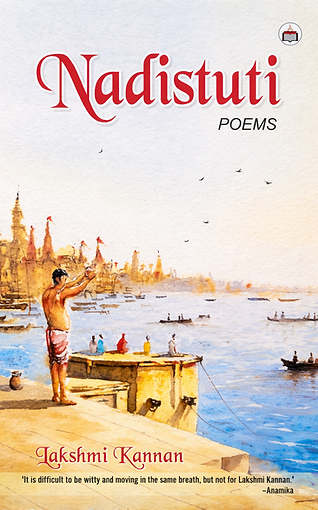
Nadistuti
Authorspress, New Delhi
2024
English
Poetry
This poetry book is a powerful collection of contemporary Indian poetry that explores rivers, identity, femininity, and spirituality. Rooted in the cultural and mythological significance of rivers in India, this evocative poetry book blends lyrical beauty with sharp social insight. Through themes of memory, migration, feminism, and the Covid-19 pandemic, Nadistuti offers a deeply reflective journey across landscapes both inner and external—making it a must-read for lovers of modern Indian poetry.
BOOK DESCRIPTION
At the heart of Nadistuti, a compelling collection by Lakshmi Kannan, flows a profound meditation on rivers—not merely as geographical entities, but as living symbols of memory, transformation, and identity. Inspired by the sacred Nadistuti Sukta of the Rig Veda, this volume reimagines rivers as voices that traverse time, culture, and consciousness.
In a striking moment, the ocean itself questions the poet: why rivers? The answer unfolds across the collection—rivers are not just destinations; they are journeys of becoming. Echoing the spirit of Khalil Gibran’s idea that “the river cannot go back,” these poems celebrate movement, change, and the merging of the self with the infinite.
Structured across five evocative sections, Nadistuti weaves together personal memory, mythology, feminist inquiry, and social critique:
“Naman” reflects on the emotional and human cost of the Covid-19 pandemic, capturing grief, resilience, and collective memory through deeply moving imagery.
“Nadistuti”, the central section, gives voice to India’s sacred rivers—Ganga, Yamuna, Godavari, Saraswati, Narmada, Sindhu, Kaveri and others—transforming them into living, breathing presences. These rivers speak as mothers, witnesses, and storytellers, embodying both nurturing strength and historical continuity.
“Chamundi” foregrounds a bold feminist vision, challenging patriarchal norms and celebrating women’s anger, resilience, and transformation through powerful symbolic and narrative poems.
“Mandala” explores philosophical and spiritual dimensions, reflecting on the cyclical nature of existence, the relationship between the individual and the divine, and the fluid boundaries between tradition and modernity.
“Fireside” brings an intimate, personal touch—tracing intergenerational memories, artistic inheritance, and the enduring bonds between mothers and daughters.
Written with a distinctive blend of wit, irony, and lyrical grace, Kannan’s poetry bridges multiple worlds—English and Tamil, myth and modernity, personal and political. Her voice is at once deeply rooted and strikingly contemporary, offering fresh perspectives on identity, gender, and belonging.
Nadistuti is more than a poetry collection—it is a riverine journey through India’s cultural imagination, a feminist re-reading of tradition, and a deeply human exploration of loss, memory, and renewal.
REVIEWS AND PUBLIC APPEARANCES
“Riverscapes and Cultural Memory”: A Conversation with Lakshmi Kannan by Sudha Rai

Sudha Rai: Lakshmi, a great privilege to be in conversation with you. While I have been following closely your published work- fiction, short stories, poems and some of your translations, over the last several decades, it is your recurring poetics of water imagery and symbolism, within which is enfolded, a committed and outspoken feminism, that emerges very powerfully in your recently published volume of poems Nadistuti .
Lakshmi Kannan: It’s such a wonderful opportunity for me as well, to re-connect with you for poetry. Thanks to Professor Rajul Bhargava’s event “Revisioning Voices” that has brought so many distinguished voices together, I am continuing with you from where we left. I vividly recall your stimulating questions for EnterText* in 2007-2008, a publication from the University of West London, U.K. I have the pleasure of including it in my website.
Sudha Rai: In your note preceding Nadistuti, you state- ‘Poetry runs on its own continuity. Poems have a way of flowing out of other poems that one has written or read.” In what way would you say your poems on the geographic riverscapes of the great rivers of India in Nadistuti connect with, evolve and flow out of similar concerns that your poems speak about in your preceding two celebrated and researched volumes- Unquiet Waters and Sipping the Jasmine Moon?
Lakshmi Kannan : In many ways they have flowed out of these two preceding books of poems Unquiet Waters (Sahitya Akademi, reissued 20012, 2007) and Sipping the Jasmine Moon (Authors Press, 2019). They gave me a feeling that there is more to be explored. In that sense, the two books opened a pathway to go further.
Sudha Rai: “Nadistuti” is the 75th hymn of the 10th Mandala of the Rig Veda, a specific hymn from ‘Nadistuti Sukta,’ a set of verses recited in praise of rivers. “Nadistuti” is the title of the second section of this particular anthology. Why did you particularly choose this title and can you also comment on the epigraph for your volume, from Kahlil Gibran’s poem?
Lakshmi Kannan: Kahlil Gibran’s poem is a powerful testimony to the experience of dissolving oneself to become a part of a larger creation, symbolized here as an ocean.
The title “Nadistuti” suggested itself to me after I completed writing the poem on the man from a humble middleclass background who gets a limited supply of water, and who has to rush for his bath in order to catch water when it flows out of the tap. I was struck by his deep Faith in reciting this sloka invoking the rivers to bestow their divinity on the waters. By the time I completed the rest of the poems, this title seemed to be the most apt for the book.
Sudha Rai: Indeed Lakshmi. I was struck by the dramatic opening of the poem that commences with… – “ Must hurry up/while there’s still running water.” For some time, I played with the thought- was this meant to suggest a subversion of the incantatory Nadistuti? That’s because your poem opens up to multiple responses. But I came round to your view that the strong faith of the man continues to work as second nature, fixed in his cultural moorings, imparting pleasure, security and sanctity.
The history and geography of riverscapes, the diversity of rivers and riverbanks as we are familiar with, have served as locations for memorable human stories in poetry and fiction . The river Himavathi in Raja Rao’s Kanthapura. A.K. Ramanujan’s famous poem ‘A River,’ describing the river Vaigai on whose banks the town of Madurai is situated. How does the ancient hymn Nadistuti in praise of rivers resonate for you in the present ?
Lakshmi Kannan: Yes indeed. Rivers have moistened many great works almost as entities with identities of their own. Whenever I get a chance to visit places that are known for their rivers – Kaveri in Srirangapatna, Karnataka; Kaveri in Srirangam, Thamizh Nadu; Ganga in Benaras, in Hardwar and in Rishikesh (Neelkanth Mahadev Temple)- I notice a deep connection between the people and the rivers. These people are as much present as I am.
Sudha Rai: As a Tamilian who imbibed Kannada as a language and culture in childhood, and was based thereafter mainly in Delhi, do any of the rivers speak more to you through the agency of both experience and recall, and why?
Lakshmi Kannan: I grew up in Mysore, and later Bangalore in a family that is bicultural. My home had a congenial climate to function in both Tamil and Kannada without any warped conflicts. The rivers in both Karnataka and Thamizh Nadu speak to me, laden with the memories of my younger years.
Sudha Rai: The riverscapes one has visited have a special emotional hold, I agree. My attachment is to the rivers Tunga and Bhadra originating in the Western Ghats in the state of Karnataka. The waters of the river Tunga felt like glass and they were described as being “sweet” when we went for a picnic there. It lingers in my memory. Basavanna, the 12th century philosopher poet with a social consciousness, took his pen name of Koodli Sangama Deva from the small town Koodli, on the banks of river Tunga.
For us as Indians, rivers and their tributaries hold deep associations, based on their mythologies, and on traditions, sacred ceremonies and rituals that constitute our cultural memories, linking past and present. For me it is the beautifully designed matrix of cultural memory that holds your Nadistuti. Can you define what cultural memory- both individual and collective - mean for you? As a poet, how do you perceive the agency of the conscious and the unconscious mind in garnering and fertilizing cultural memory?
Lakshmi Kannan: Cultural memory seems to be close to what Carl Gustav Jung, the Swiss psychiatrist, called the “collective unconscious”. When you see a large section of people with a diverse cultural mix, bonding over rivers that flow with their own weight of mythology and legends, one gets an exhilarating sense of becoming one with them, no matter what region one comes. To be one with the people in Haridwar or Benaras is an expansive experience. Still, there is also an individual memory of a river that one associates with childhood, youth or one’s later years in life.
Sudha Rai: Rivers in India are worshipped largely as goddesses. The worship of rivers as goddesses stands in ironic contrast to the unjust, brutal repression of the life and identity of the girl child, and of women, under patriarchal Indian socio-cultural systems . I am struck by the power of poetic irony to effectively reverse the power of cultural myths ingrained in cultural memory, in your subtly worked out dream sequence in the poem “Snake Woman.” How did this poem come to you?
Lakshmi Kannan: The poem is based on an actual dream. When my mother was pregnant with me, she dreamt of a baby female snake repeatedly. When she narrated it to me, I was stunned by the way it had translated into reality in her personal life.
Sudha Rai: I was absolutely bowled over by your use of intertextuality in the poem “Muniyakka in Maximum City,” and in the poem as a tribute to her Hindi translator “ Bala Sir” from Nadistuti. (SR reads from Bala Sir’s regional memory. Millet is now retrieved as a health and fashion food. “.. her wacky humour/ laced with slangy Kannada/smells of the millet balls/she washes down with a spicy broth.” page 25)
What an astonishing characterization, and deployment of the regional voice too, to bring home your memorable creation, the ‘feisty’ Muniyakka! How would you describe and explain your own, and your readers’ and critics connection with ‘dear’ Muniyakka?
Lakshmi Kannan: Some of us were approached by a poet friend Anita Nahal who is based in Washington, to contribute to her anthology titled Soul Spaces: Cities, Towns, and Villages (Authors Press, 2022) along with an edit team that included other writers such as Prof. Malashri Lal, who is here. It made us look inward, even though most of us are now comfortably settled in our mega Maximum cities. The cosmopolitan Bangalore is definitely one of them. When I sat down to write, Muniyakka came on the page unbidden, and with a life of her own. She is happy to live within her own skin. In Bangalore, she carries a piece of Kokkina Halli (her village) within herself, and her firm belief in the support of a good devil (in Kannada, olle pichachi) and alertness about the bad devil (in Kannada, kettu pichachi) gives her supreme confidence. Frankly, I am surprised that this old feisty maid from very humble circumstances, should find such unlikely fans from the Western world of literature and from the sophisticated Indian literary fraternity, as if she is their alter-ego. It’s puzzling.
Sudha Rai: I’d like to turn now to dwell a bit on the distinctive feature of the autobiographical poems in the section ‘Fireside’ in Nadistuti. A very charged and emotional section of the anthology marked by fortitude, quietude, and most of all the deep flow of gratitude.
Lakshmi Kannan: That’s right. The poems in “Fireside” are all about gratitude. I owe a lot to my family, my mentors and friends and I wanted to leave a record of that in poetry.
Sudha Rai: In the opening section “Naman” you refer to the harrowing experience of Covid-19. A number of fine anthologies of poetry have been published after Covid-19. What kind of impact did the pandemic have on you as an individual and as a writer?
Lakshmi Kannan: It was a cathartic experience, a close brush with death. Like many others, I too lost friends and acquaintances. Again, one learnt to be grateful for whatever one had and learn to treasure this ephemeral life.
Sudha Rai: Before we conclude , I must comment very briefly on one of your most lyrical poems here- the title is ‘Prose Poem: Ponni looks back.’ Ponni is the name of the river Kaveri in classical Tamil literature, and your long narrative poem mingles so wondrously the journey of the river from its 4ft by 4 ft small beginnings to the large expanse of the river Kaveri, with the history of the Hoysala and Chola dynasties, the voice of the river claiming its place in cultural memory.
The lines –“I was their timeless Ponni, flowing within their bloodstream, living in their psyche for generations after generations. I lost count of the centuries. I was their inerasable memory.”
Thank you so much Lakshmi for sharing your thoughts, your deep perceptions on India’s rivers, and cultural memory, and for building remembrances for each one of us, of the importance of poetry in rethinking our role in the preservation of culture.
Lakshmi Kannan: The pleasure is entirely mine, Sudha. Thanks immensely. So many things became clearer for me while responding to your questions. We should thank Professor Rajul Bhargava once again, for giving us this wonderful platform to share our views with a distinguished audience who tuned in to our conversation. Thank you and Namaskhar.

Review by Malashri Lal
The title plunges us into the sacrality of resonant words, the Nadistuti Sukta being a hymn in the Rigveda in praise of rivers. Poet, novelist and translator Lakshmi-Kaaveri equates the flow of the waters with the ‘flow of poetry’, the quiet mingling streams of remembrance and phrases that shape the lines of verse. Her book is dedicated to Jayanta Mahapatra ‘who lives on’ and an exordium titled ‘Naman’ offers gentle tribute to H.K.Kaul, who was among the founders of The Poetry Society of India and passes away during the recent pandemic. Nadistuti is a brilliant and thought-provoking collection of poems that charts the timeless continuums while being aware of the fragility of human existence.
The book begins with a prayer to the River Narmada (meaning ‘the giver of pleasure’) which divides the north from the south of India. Remembering Ganga, Yamuna, Godavari, Saraswati, Narmada, Sindhu, Kaaveri, devotees recite the shloka at their morning bath, seeking the blessings of the rivers. Though such rituals are mostly forgotten in modern times, the climate crisis should remind us of the consequences of such amnesia. The invisible Saraswati is possibly a metaphor for such “forgetting” simply because of her partial invisibility. Lakshmi Kannan’s vibrant lines recall the disappearance of the river as also of Saraswati’s appearance in another form as a revered Goddess invoked by “students, writers, musicians, dancers, painters.” From the Nadistuti I learned the word – ‘potamologist’ – the study of rivers, but the book is far greater than an academic enquiry – it’s a recognition of the civilizational bloodline that is linked to the ancient rivers which were the earliest cradles of humankind.
Some extraordinary and innovative aspects of Lakshmi’s book deserve special mention. First, the remarkable prose-poem called “Ponni Looks Back” which stretches the boundaries of imagination in a charming manner. Ponni is the name of the river Kaaveri in classical Tamil literature. It flows through Tamil Nadu and Karnataka and is always perceived as a woman. Lakshmi tracks Ponni’s autobiography as though writing a Bildungsroman, the education and growing up of an innocent girl and her experiences along the way. Therefore, Ponni is born as a small unobtrusive stream on the Mysore-Coorg border. Then she becomes prominent and significant, and a vital witness to history – the Hoysala kingdom, the classical arts of Belur, Halebid, Somnathpur, then carrying on further to wrap around the islands of Srirangapatnam and so on. I enjoyed the autobiographical voice of Ponni reveling in her centuries of testimony to all the changes she has observed and imbibed – till we come to the new politics that is destroying rivers and society today. Ponni says, “One day I heard different voices floating over my waters…they sit around tables, shout at each other and refer to me dryly as ‘the Kaaveri dispute’, wrenching my waters apart.” Like yet another goddess, Sita, she chooses to end her journey. Ponni merges with her mother, the Bay of Bengal – her love and amity having completed what tasks she could undertake towards humanitarian goals. The world of manmade disaster is a chapter River Kaaveri would rather not participate in.
My question here is: “Do poetry and politics merge? Can poets continue to be as Shelley called them “the unacknowledged legislators of the world?” This brings me to another significant aspect of Nadistuti: Lakshmi’s brand of subtle feminism. Predictably, I am drawn to the poems that argue against son-preference, challenge gender stereotypes and poke gentle barbs at unenlightened men.
Second, I cite a longish poem called “Snake Woman” from the section titled Chamundi, because it combines rituals, dream imagery, gender prejudice and the paradox of son preference. The ritual is called Nagapuja and has strict abstinence from certain foods like snake gourd, and it entails hours of prayers- the chant being:
Please grant me a male child
Oh, King of Cobras
I will name him Nagaraja
In your honour.
Something strange started happening that the pregnant woman could never dare reveal to the world. She dreams every night of a female baby cobra wearing jhumkies (long earrings) and a jeweled girdle, sporting a red dot on her forehead. Well, the baby born was female – and the happy mother, though a little fearful, called her Nagalakshmi. The mother-in-law showed acute displeasure: “She can have any name. Who cares!”
Another pregnancy, again the rituals of Nagapuja – more stringent than before. No dreams this time. And an eagerly welcomed boy-child is born, enthusiastically named Nagaraja.
And guess what?
As he grows up, he
hissed at his mother,
bared his fangs at his father,
and spewed venom on his sister.
These are Lakshmi Kannan’s vivid vocabulary for the revered son! And the snake-woman sister, what happened to her? She sloughed off her skin seasonally, grew strong, capable and emerged as a “lustrous one.”
I selected this poem for more than just Lakshmi’s clever reversal of gender prejudice. Snakes have a central place in the folktales of India. The word used “theriomorphic”, denotes situations, where animals and human beings interchange bodies and identities. Snakes are not evil – they are progenitors of good deeds and the shapeshifting happens for commendable reasons. The figuration of the snake as exclusively evil does not derive from Indian mythology. Lakshmi’s poem, this one and several others, tread this beautiful territory of human and non-human sharing a common abode, the Earth, and there is an implied lament that we have ignored this vital connectivity.
And finally, I am delving into the emotive, personal poems that end the collection. Called ‘Fireside’, it invites memories of Y.B Yeats’ classic lines:
When you are old and grey and full of sleep,
And nodding by the fire, take down this book…
Lakshmi addresses many members of her family; they are named, thanked and remembered for their acts of love and compassion. Because Lakshmi believes in histories and continuities, as we have seen in ‘Ponni Looks Back’, and the Nagalakshmi reference, these too are poems about lineage, heritage, respect and love – the attributes that make life worthwhile. Lakshmi’s mother (addressed in the poems as Amma) was Sarada Devi, an acclaimed painter in Mysore and Bangalore whom the daughter remembers with her easel-mounted canvas gently acquiring colours, the landscapes emerging from the contours of her imagination. Today, Lakshmi Kannan, the poet of Nadistuti, looks at a blank sheet of paper and compares that to her mother’s canvas – the words will surely incarnate. Another poem has a redolent title ‘In Search of Father’s Gardens’, upturning African American writer Alice Walker’s book In Search of Our Mother’s Gardens, but for me it is a tale reminiscent of Lakshmi Kannan’s early novel Going Home that I had reviewed decades ago. It was a book about ancestral homes and families breaking up. In the configuration over time, Nadistuti’s final section presents poems to members of Lakshmi’s immediate family, named, but not too personalized, making this an exemplary template for those who hesitate to present the private in public poetry. With beauty, grace, gratitude, humour, irony – each person emerges as a tributary in the flow of the poet and writer we know and love as Lakshmi – Kaaveri. The last poem ‘If You Want to Visit’ is deeply poignant. It’s not a farewell poem – instead it’s an invitation to an eternal companionship.
Come
Visit me now
I’ll not have a word of complaint
I’ll gather all of these and leave with you.
Here is the confluence of all that Nadistuti says: the day’s prayers in the morning, the Ponni river encapsulating history, the rituals that pass through many generations, and the legacy of a poet’s words embedded in the annals of time. An exquisite and meaningful collection of poems, Lakshmi has introduced concepts of poetic writing that are evocative of the ancient Rigveda and equally provide the guiding lamp for modern choices.
Published in Borderless Journal, May 2024, Singapore
Review by Sanjukta Dasgupta
Poet Lakshmi Kannan’s wry sense of humour instils exuberance and epistemic waywardness in a book of poems that apparently may create the impression, no less from the cover, that the poems are eco-spiritual, benign, adulatory and worshipful. The signifier ‘stuti’ can be variously interpreted by informed readers. Essentially the title Nadistuti can be literally interpreted as hymns in praise of the river. The Sanskrit word ‘stuti’ implies adulation, praise, respectful homage, but can be used again as tongue in cheek lip-service, commonly derided as ‘stuti-vakya’, used by sycophants for ulterior motives.
Indian poets writing in English have engaged the river in varied ways. While A K Ramanujan’s poem ‘A River’ describing the Vaiki river ‘can be poetic once a year;’ and then turn recklessly destructive as it carries away ‘three village houses’; Mamang Dai’s poem ‘Small towns and the River’ resonates with the single line ‘the river has a soul’. Rivers have been the lifeline of India’s agrarian economy, social life and means of livelihood. The rivers Ganga, the Brahmaputra, Mahanadi and the Padma in Bangladesh are admired and feared as these can feed, fertilize and destroy at will. But among them all, the Ganga emerging from the Himalayas and cascading down through the fertile eastern plains and diving into the arms of the Bay of Bengal, is traditionally regarded as a holy river by followers of the Hindu religion.
But Lakshmi Kannan is a stand-alone poet. In her poem ‘Ganga, Her Many Faces’ not unlike the poet Ramanujan, she states that the Ganga is regarded as the most sacred and the most polluted river ‘in the same breath’, with its Ganga Arti, the burning of dead bodies and its ghats teeming ‘with the living.’ Kannan’s candour and precision are unmistakable. In her poems we notice how intellect can be poised at the tip of the senses, an ability that T S Eliot had memorably described as a defining attribute of the poetry of John Donne.
If one asks Google about Indian rivers the response is a data approximation. The purpose of Lakshmi Kannan’s poetry is entirely in opposition to Google’s staid summing up of Indian rivers, which is often offered as the model definition that IAS examinees are expected to memorize. So, quite noticeably in her preamble, the poet Kannan states, “Poetry runs on its own continuity. Poems have a way of flowing out of other poems that one has written or read.”
In this regard, the title poem ‘Nadistuti’ is exceptional, profound and irreverent at the same time. The jocularity in the lines is unmistakable. In very few phrases the poem adroitly presents a penetrating representation of a culture, that remains deep-rooted in timeless, conservative customs and tradition while it simultaneously adjusts and co-exists peacefully with the erratic water supply of the municipality. In her Foreword to Kannan’s book Dr Anamika has commended Lakshmi Kannan’s ability to fuse wit and empathy in the same breath in her poetry. Dr Anamika further observed that in Kannan’s poetry readers may discover ‘egalitarian ethics’ as she deftly uses legend, history and the intersections that categorize the diversity of the contemporary eco system.
The poems in Kannan’s Nadistuti are divided into five sections. These are Naman, Nadistuti, Chamundi, Mandala and Fireside. In the short Naman section, all four poems are a tribute to the dear departed, ruthlessly claimed by the unprecedented covid pandemic. Memory, pain and the discipline of letting go are manifest in these four elegiac poems addressed to H K Kaul, Bala sir, Meditative Mother and Vasundhara. In the ‘Nadistuti’ section the river ‘Narmade’ is complimented for its phonetic affinity to the Tamil tongue. Remarkably, the cook too joins in venerating the Narmada River, “Whatever is made with your waters/tastes like the food prepared by Nala”. Nala, is a character in the epic Mahabharata, known for his culinary skills, Kannan mentions in her scholarly notes. Moreover, Kannan adds that Nala wrote the first book on cookery titled, ‘Pakadarpanam.’
Also, in her poem, ‘The Only Son’, with an impish chuckle as it were, Kannan almost patronizingly pats the river Brahmaputra, ‘you have done us proud’ as the sole son, the only brother of the seven sisters ‘Ganga, Yamuna, Godavari, Saraswati, Narmada, Sindhu, Kaveri’.
The invisible, subterranean river Saraswati flows in the bloodstream of all creative artists, scholars and performers, writes Kannan in her poem, ‘Sarasvati’. Playfulness is manifest in the poet’s dialogue with the ocean in the poem, ‘Said the Ocean’, where the poet chastises the ocean for absorbing all the rivers and their individual names in its “expansive embrace.”. Kannan’s prose poem, ‘Ponni Looks Back’ reads like a docu-memoir, that traces the birth and journey of the river Kaveri. As in her poems, the skilled use of the first person in this prose poem creates a dramatic immediacy that captivates the reader.
Apart from wit, humour and word-play, a subtle sense of drama, mostly covert, in Kannan’s poetry, make her poems resonate for long in the minds of readers. The poem, ‘High and Dry’, which refers to the Gomti river, will remind readers of Ramanujan’s poem, ‘A River’, as Kannan writes that the Gomti could well ‘gobble’ boats, cattle, huts or a whole village”.
In the third section titled ‘Chamundi’, goddess Kali is described as ‘fury personified’ followed by a pert suffix, ‘anger becomes her.’ While the poem ‘Basant Panchami’ ends with the message, ‘Beti padao’. Son preference is ridiculed in the feminist poem, ‘Snake Woman’, that deconstructs traditional beliefs and rituals.
The first poem in the ‘Mandala’ section, ’14 April, 2020’ addresses itself to the neem tree that seemed to have become oblivious that the month of April was its flowering time. The poet muses that perhaps the shock of the rampaging Covid pandemic had effectively stalled the routine blossoming of neem flowers, as the neem tree perhaps was in mourning. The poem, ‘Dream Book’ projects a deep understanding of desire and dreams that the social ecosystem seems impervious to. Even if the poetic persona desires to chase her dreams, the world around would hold her back, for her own welfare, the poem implies wryly.
In the final section, ‘Fireside’ the poems are overtly autobiographical, addressed to parents and family members, while there is also a poem about the naming of the poet of ‘Nadistuti’. Once again, the use of dialogue and monologue, instils vigour in the images, symbols and metaphors, as in the four earlier sections of this extraordinarily rich volume of poems. Lakshmi Kannan’s Nadistuti is an outstanding addition to the corpus of 21st century Indian poetry written in impeccable English.
Published in Muse India the Literary ejournal Issue 117 (Sept-Oct 2024)
Review by Sudha Rai
Bi-lingual Indian Poet, Short story writer, Novelist, Translator and Critic, Lakshmi Kannan, stands out with distinction as a major poet in the modern Indian literary panorama. In Nadistuti, her fifth volume of poems ( Authorspress, 2024) , she returns to her readers with a deepening of the significance of water in her canon, bringing new and sharp insights on patriarchy and women in Indian society, on the struggles of the middle class, and on the spiritual life-affirming vitality of the rootedness of Indian culture in its rivers.
Kannan’s adoption of the pen name ‘Kaaveri’ for her writing in Tamil, imparts an added mystique over the decades, to her deeply felt connection with the medium of water. The poems from her preceding two celebrated poetry collections Unquiet Waters (2005;2012) and Sipping the Jasmine Moon,(2019) had established her signature sharp-angled feminist critique of the unequal status accorded to women in India, resonating women’s subjugation, articulating their modes of resistance too.
As an intertextual formation, Kannan evokes and carries forward creatively, ‘Nadistuti,’ the 75th hymn of the 10th Mandala of the Rig Veda, a hymn from ‘Nadistuti Sukta,’ a set of verses recited in praise of rivers. As Kannan spells out, the hymn in which India’s magnificent rivers, called out to by their names- Narmade, Sindhu, Kaveri, Godavari, Sarasvati, Gange , and Yamuna, invoked to bestow their divinity on their waters, were considered important for the geographic construction of the Vedic civilization, Nadistuti brings home in its five sections demarcated as ‘Naman,’ ‘Nadistuti,’ ‘Chamundi,’ ‘Mandala’ and ‘Fireside,’ a brilliant assemblage of Kannan’s recent poems. Enwrapped beautifully in a wide variety of narrative and poetic forms, the symbiotic relationship between riverines and the feminine, is pursued by the poet, casting aside idealizations , advancing concrete sketches of the human drama in the cosmic play.
Covid-19 swept away innumerable human lives. In the four poems that belong to the section ‘Naman,’ Kannan pays homage to fellow poets, and to others who have been claimed in one fell swoop. Dramatizing the horrors of “the big scourge,’ the poet blends in the poem “Meditative Mother,” vivid detail with a meaningful message: ‘Around her, / the nation screamed for ‘Oxygen!’, Perhaps for the first time, people realized/they had taken it for granted,/ like a mother’s presence. In the poignant “Vasundhara’s Last Journey,” the poet swivels between two points of view effortlessly- the first being the observing consciousness of Vasundhara herself, as her dead body is taken for cremation. The second is the third person third person narrative point of view that records the coming together (for once perhaps) of the entire neighbourhood in deeply felt empathy. The totality of effect Kannan achieves through such swivelling can perhaps be best appreciated by relating it to the techniques of the cinematic camera.
Published in Confluence: South Asian Perspectives, London, U.K. Feb-March, 2024.


